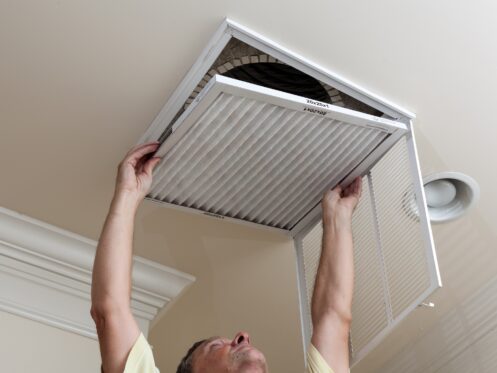
A central HVAC system can reduce wildfire smoke particles inside your home. It does this by moving indoor air through a filter. However, it can’t keep all smoke out.
Smoke from a Minnesota wildfire or a distant fire can enter through doors, small gaps, and ventilation equipment. Running your central air conditioner, using the right filter, and adding an air purifier can help improve your indoor air.
How Does Wildfire Smoke Affect Indoor Air Quality?
Wildfire smoke contains gases and very small particles called PM2.5. Wind can carry these particles hundreds of miles. Smoke can affect Rochester even when the fire isn’t nearby.
Smoke may enter through:
- Open windows and exterior doors
- Gaps around windows, pipes, and wires
- Fresh-air intakes
- Ventilation systems
- Leaky ducts
- People entering and leaving the home
Closing your windows and doors helps, but your home isn’t completely sealed. Outdoor air can still pass through small gaps. Exhaust fans may also pull outdoor air inside.
Don’t rely on smell alone. Smoke particles may remain indoors even when you don’t notice an odor.
Should You Run Your Central HVAC During Wildfire Smoke?
You can usually keep running your central air conditioner when the outdoor air is smoky. Most residential systems reuse air from inside the home. They pull it through return vents, pass it through a filter, and send it back into the rooms.
During a smoke event:
- Keep windows and exterior doors closed.
- Use a recirculation setting when available.
- Check whether your home has a fresh-air intake.
- Make sure the filter cabinet closes tightly.
- Keep supply and return vents open.
Some homes have an air exchanger that brings in outdoor air. Ask an HVAC professional how to use this equipment during a smoke event. Don’t block the intake on your own, since that could cause ventilation or moisture problems.
What Type of HVAC Filter Is Best for Wildfire Smoke?
A filter’s MERV rating shows how well it captures particles. A basic filter may catch lint and large dust particles but miss smaller smoke particles.
A MERV 13 filter is often recommended for smoke when the HVAC system can safely handle it. However, a higher rating can make it harder for air to pass through the filter.
Confirm Filter Compatibility First
Some HVAC systems can’t handle the added resistance of a high-efficiency filter. The wrong filter may cause weak airflow, poor cooling, ice on the indoor coil, or extra strain on the blower.
Check your equipment manual before upgrading. A technician can also test the airflow and recommend air purifiers and filters that work with your system.
Make Sure the Filter Fits Correctly
Air can move around a filter when it doesn’t fit the cabinet. That means some smoke-filled air may return to your rooms without being filtered.
Use the exact filter size listed on the old filter or inside the cabinet. Check its width, height, and thickness. Don’t bend a filter or try to force the wrong size into the slot.
The filter also has an arrow that shows the direction of airflow. This arrow should normally point toward the blower. Close the filter door firmly after installation so air can’t leak around it.
Check Filters More Often During Smoke Events
Wildfire smoke can make a filter dirty faster. Check it during the smoke event and again after the outdoor air improves.
Air filter replacement may be needed when the filter looks dirty, airflow becomes weaker, or the manufacturer recommends a change. A filter that normally lasts three months may need earlier replacement during heavy smoke.
Keep a clean replacement filter at home. Common sizes may be harder to find during a large air-quality event.
When to Consider Targeted Indoor Air Quality Solutions
A standard HVAC filter may not be enough for every home. It only filters air while the system is circulating it. It may also struggle when a lot of smoke gets inside.
Consider additional indoor air quality equipment when:
- Wildfire smoke affects Rochester often.
- Someone in your home is sensitive to poor air quality.
- Smoke odors remain indoors.
- Your system can’t use a MERV 13 filter.
- You want more help with dust and pollen.
No filter or purifier removes every pollutant. These products also can’t stop new smoke from entering. They help reduce the particles already inside.
Install a Whole-Home Air Purifier
A whole-home air purifier connects to the central duct system. It treats air as the HVAC system moves it through the house.
A purifier may capture smaller particles than a basic filter. It can treat the ducted parts of the home without requiring a portable unit in each room. It also provides year-round help with dust, pollen, and other particles.
Professional air purifier installation is important. The equipment must match the ductwork and HVAC blower. A technician can recommend a purifier that won’t block needed airflow.
How Should You Use Your HVAC System When There’s Poor Air Quality?
Take these steps when wildfire smoke reaches Rochester:
- Close windows and exterior doors.
- Use the recirculation setting when available.
- Check the filter and replace it if needed.
- Use the strongest filter the system can safely handle.
- Keep supply and return vents open.
- Move furniture and rugs away from vents.
- Run the system normally for cooling.
- Avoid candles and wood-burning fireplaces.
- Watch local air-quality reports.
You usually don’t need to turn off a central air conditioner because the outdoor air is smoky. Running it keeps the home cool while moving indoor air through the filter.
What Should You Do to Combat Poor Air Quality From Wildfires?
Prepare before Rochester is under an air-quality alert. Identify your filter size and keep clean replacements at home.
Schedule air conditioning maintenance before the main cooling season. Ask the technician to check the system’s airflow, filter cabinet, ducts, and outdoor-air equipment.
You should also learn how to install the filter, repair visible duct leaks, and review the thermostat’s fan settings. If smoke affects your home often, consider whole-home air purifier installation.
A professional can check whether your air conditioner or heat pump can support a better filter. This helps you improve filtration without causing weak airflow, ice, or poor cooling.
Improve Your Indoor Air With Haley Comfort Systems
Your HVAC system can’t keep every smoke particle out. However, the right filter, good airflow, sealed ducts, and a whole-home purifier can reduce smoke in your indoor air.
Prepare before the next Minnesota wildfire affects Rochester. Contact Haley Comfort Systems to schedule an HVAC inspection or professional air purifier installation.